


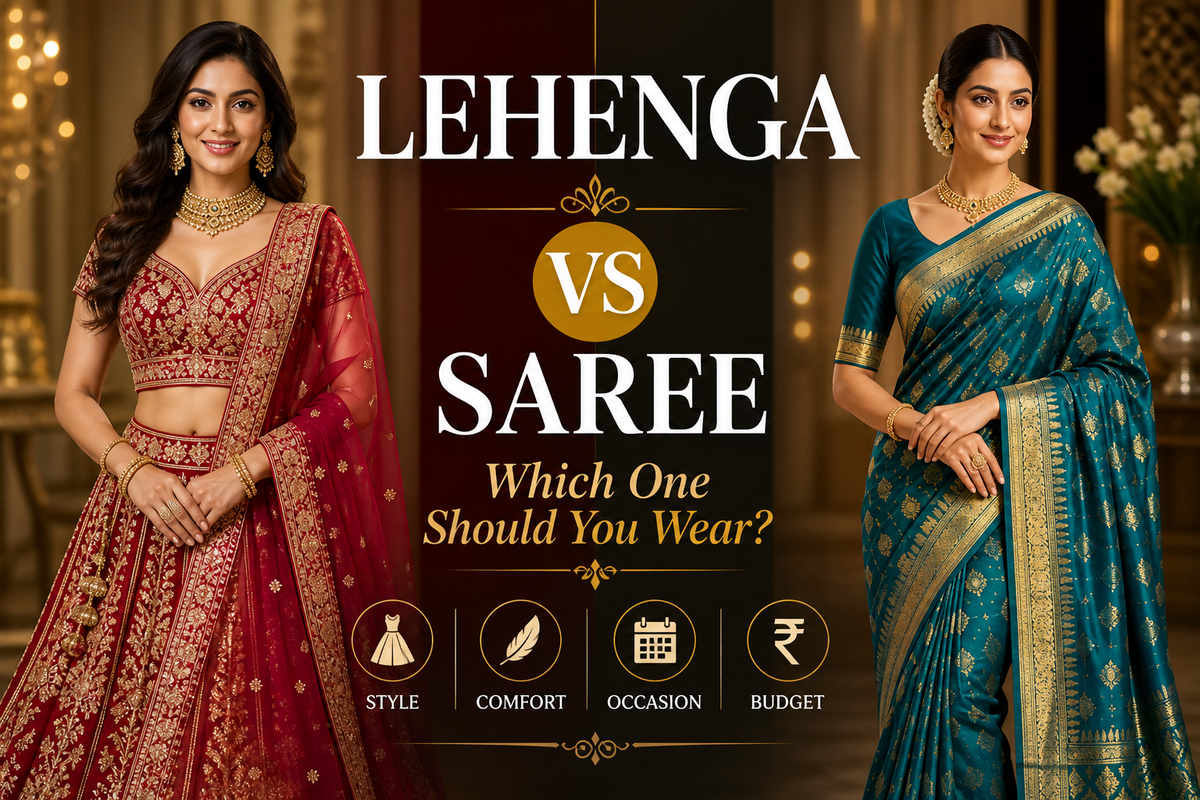
In short: A lehenga choli is a stitched 3-piece outfit: a flared skirt, a fitted blouse (choli), and a dupatta. Easy to wear, structured silhouette, no draping skill needed. A saree is a single unstitched fabric of 5 to 9 yards that you drape around your body. Timeless, versatile, and wearable in 80+ different styles. Choose a lehenga if you want maximum impact without draping effort, plan to dance, or are wearing ethnic wear for the first time. Choose a saree if you want timeless grace, plan to rewear it across many occasions, or are dressing for a formal or traditional setting.
What Is the Difference Between a Lehenga Choli and a Saree?
Let us start with the basics before we get into the comparison. A lehenga choli is a three-piece outfit. You get a flared skirt (the lehenga), a fitted blouse (the choli), and a long scarf (the dupatta). All three pieces are fully stitched and ready to wear. You put it on like any other outfit. No draping, no pins, no practice needed. Fabrics range from silk, georgette, and net to velvet and organza. The embroidery work can be anything from simple thread embroidery to heavy zari, zardosi, and mirror work. A saree is one single piece of unstitched fabric. It runs between 5 to 9 yards depending on the style and region. You wrap and drape it around your body, tuck it into a petticoat, and bring the loose end (the pallu) over your shoulder. There are over 80 draping styles across India: the Nivi drape, the Bengali drape, the Gujarati drape, the seedha pallu, and many more. Popular fabrics include Kanjivaram silk, Banarasi silk, georgette, chiffon, cotton, and linen. Both spellings, saree and sari, refer to the same garment.| Lehenga Choli | Saree |
|---|---|
| 3 separate stitched pieces | 1 continuous unstitched fabric |
| Skirt + blouse (choli) + dupatta | 5 to 9 yards, draped on the body |
| No draping required | Requires draping skill or help |
How Are a Lehenga and Saree Different: A Full Side-by-Side Comparison?
If you want to see both outfits compared at a glance, this table covers everything.| Factor | Lehenga Choli | Saree |
|---|---|---|
| Structure | Stitched, 3 separate pieces | Unstitched, 1 fabric draped on body |
| Ease of wearing | Easy, wear like any other outfit | Requires draping practice or help |
| Silhouette | Defined, flared, fitted at the waist | Fluid, draped, wrapped |
| Fabric range | Silk, velvet, georgette, net, organza | Silk, cotton, chiffon, linen, crepe |
| Embellishment | Zari, zardosi, sequins, mirror work, stone | Zari border, woven motifs, printed designs |
| Body coverage | Full coverage including the midriff | Midriff is typically visible |
| Occasion range | Wedding, sangeet, mehndi, Navratri, engagement | Wedding, reception, office, puja, daily wear |
| Reusability | Moderate, restyle the blouse or dupatta | High, 80 plus draping styles from one fabric |
| Price range | Rs. 2,000 to Rs. 5,00,000 and above | Rs. 500 to Rs. 2,00,000 and above |
Which Is More Comfortable and Easier to Wear: Lehenga or Saree?
This depends on two things: your experience with the outfit and what you are wearing it for. A lehenga choli is the easier option for most women. It is fully stitched, so there are no pins, no tucking, and no risk of the outfit falling apart in the middle of a function. The waistband holds everything in place. The flared skirt gives you full freedom of movement, which is why it is the go-to choice for sangeet nights and Navratri garba. You can put it on yourself in under ten minutes without any help. If you are wearing ethnic wear for the first time or you simply do not want to think about your outfit at the event, a lehenga is the safer pick. A saree, once draped well, can feel just as comfortable. A cotton saree on a mild day for a two-hour puja is one of the most comfortable things you can wear. A linen saree for a day function is light and breathable. Georgette and chiffon sarees drape softly and feel easy on the body. The challenge is the draping itself. Until you have done it enough times, a saree takes practice and often needs another person to help. That is not a flaw in the garment, it is just a skill that takes time. Here is the real answer though. Comfort is not just about the garment type. It is about fabric, weather, and how long you will be wearing it. A heavy velvet lehenga at an outdoor summer wedding will tire you out fast. A georgette saree at a five-hour function where you are constantly adjusting the pallu and re-tucking the pleats is no fun either. Match your fabric to your season and your event duration, and both garments become comfortable choices. If you love the look of a saree but are not confident draping one yet, ready-to-wear sarees are a practical middle ground: the elegance of a saree with the ease of a lehenga.Which Suits Your Body Type Better: Lehenga or Saree?
The answer changes depending on your frame. Here is a body-type breakdown so you can make the most flattering choice. For a deeper guide on dressing for your body shape in Indian wear, read our article on how to dress as per your body shape.Hourglass Body Type
You are in a good position here because both outfits work well for you. A fitted choli with a flared lehenga skirt accentuates your waist naturally. A silk or georgette saree does the same by following the natural curve of your frame. Pick based on occasion and comfort, not body type.Pear or Bottom-Heavy Body Type
For a lehenga, go with a lighter fabric like georgette or net for the skirt. Avoid heavy embroidery concentrated at the hem because it pulls the eye downward. Instead, put the detail on the blouse to draw attention upward. For a saree, a solid fabric with a border drape balances the difference between your shoulder and hip width. A well-fitted blouse with a wider neckline helps create shoulder emphasis. A saree works slightly better here because the draping gives you more control over how your silhouette reads.Apple or Tummy-Focused Body Type
Go with a lehenga. A high-waist skirt paired with a longer choli that covers the midriff gives you full control over the silhouette. Avoid crop tops here. For a saree, the butterfly or seedha pallu drape with a firm petticoat works well, but you need to avoid sheer fabrics like chiffon or organza which reveal rather than conceal. The lehenga wins because you do not need draping skill to get the fit right.Petite or Shorter Frame
For a lehenga, vertical embroidery patterns and a high-waist skirt create the illusion of height. Keep the dupatta light so it does not cut your visual line. For a saree, a single-colour fabric with a thin contrasting border worn with heels adds length to the frame. Both work equally well here. The deciding factor is whether you want to wear heels or not.Plus Size
Both outfits are strong choices for plus size women when the silhouette and fabric are right. For a lehenga, an A-line skirt in flowing georgette or net with a well-fitted choli is one of the most flattering options in ethnic wear. Keep embellishment moderate because very heavy stone or sequin work adds visual bulk. For a saree, go with georgette or cotton in jewel tones or deeper shades. Clean draping with enough fabric to form neat pleats makes a big difference. Browse our plus size lehenga choli collection for fits designed specifically with this in mind.Lehenga or Saree: Which Is Better for Weddings, Festivals, and Parties?
The occasion often makes the decision for you. Here is what works best for each setting.Which Is Better for a Bridal Look?
A bridal lehenga choli gives you the most embellishment canvas of any Indian outfit. Heavy zardosi, stone work, velvet, and net layering photograph dramatically under wedding lighting. You can sit on the floor for rituals, do pheras, and dance at the sangeet without worrying about your outfit. This is the dominant bridal choice in North, West, and Central Indian weddings. Check our guide on latest wedding lehenga trends if you are still deciding on a style. A bridal saree in Kanjivaram silk or Banarasi carries deep generational weight. In South and East Indian weddings, the saree is not an option, it is the tradition. The draping is usually done by a family member or a professional, which makes it a shared experience in itself. First-time wearer wanting ease and drama: choose the lehenga. If your family tradition calls for a saree: wear the saree. Neither is the wrong answer.Which Is Better for Wedding Guests?
A party wear lehenga in georgette or net is festive, easy to manage across a full wedding day, and works well for group coordination like bridesmaids. A party wear saree in silk or a designer print remains the classic guest choice, particularly for women who want to look polished at a religious ceremony or a formal reception. For more ideas, see our wedding guest outfit ideas guide. Both are equally appropriate. Lehenga suits younger or first-time guests. Saree suits those who want a more classic look.Which Is Better for Navratri, Diwali, and Festive Occasions?
For Navratri, the Navratri lehenga wins without contest. The chaniya choli is the traditional Navratri garment. You need full freedom of movement for garba, and the vibrant colours, mirror work, and bandhani prints of a lehenga are made for exactly this occasion. For Diwali, it is a personal call. Silk and organza sarees with zari borders are a Diwali staple for women who prefer a traditional look. Younger shoppers often reach for a lehenga for Diwali evening celebrations.Which Is Better for Office Functions or Day Events?
The saree is the clear winner here. A cotton, linen, or printed casual saree is professional, practical, and comfortable for half-day or full-day office events. A well-pinned saree in a subtle print reads as polished in any formal setting. A lehenga is too festive for most office contexts unless it is a semi-formal cultural function.Lehenga vs Saree: Which Costs More and Which Gives Better Value?
The most common assumption is that sarees are always cheaper than lehengas. That is only true at the entry level. Here is the full picture.| Budget Tier | Lehenga Choli | Saree |
|---|---|---|
| Budget | Rs. 2,000 to Rs. 8,000 | Rs. 500 to Rs. 5,000 |
| Mid-range | Rs. 8,000 to Rs. 30,000 | Rs. 5,000 to Rs. 25,000 |
| Premium and Designer | Rs. 30,000 to Rs. 1,00,000 | Rs. 25,000 to Rs. 80,000 |
| Luxury and Bridal | Rs. 1,00,000 to Rs. 5,00,000 and above | Rs. 80,000 to Rs. 2,00,000 and above |
Which Gives You More Styling Options: Lehenga or Saree?
Both outfits offer more variety than most people realise. The difference is where that variety comes from. With a lehenga, the styling range comes from silhouette and embellishment combinations. You can wear a crop top lehenga for a contemporary look, an Indo-western jacket lehenga for a fusion feel, a Rajasthani lehenga for a traditional festive look, or a simple A-line lehenga in a floral print for a lighter occasion. The dupatta adds another layer of styling options: drape it in the traditional front style, throw it over one shoulder, use it as a cape, or belt it at the waist for a modern silhouette. If you want to rewear the outfit, swapping the blouse changes the entire look without spending on a new lehenga. A saree gives you more raw variety than any other Indian outfit. The same 6-yard fabric can be draped in over 80 different styles across India. A Nivi drape, a Bengali drape, a Gujarati drape, a seedha pallu, a butterfly drape, or a gown-style drape all look like completely different outfits even though it is the same saree. Add to that the range of blouse styles available: sleeveless, full sleeve, halter neck, deep back, or peplum. A designer saree in the right fabric can be dressed up or dressed down depending entirely on how you style it. For practical ideas on how to do this, read our guide on how to restyle a saree in different ways. If you love experimenting with different looks, a saree gives you more mileage from a single purchase. If you want one look done perfectly with no guesswork on the day, a lehenga is the better call. Both are valid. It comes down to your relationship with your outfit.What Are the Pros and Cons of Lehenga vs Saree?
Before you make your final call, here is a clean summary of where each outfit stands.Pros and Cons of Lehenga Choli
Pros- Easy to wear without any help or draping skill
- Structured silhouette that can be tailored to your body type
- Full freedom of movement, ideal for dancing, floor-sitting, and rituals
- Heavy embellishment like zardosi, stone, and mirror work photographs well at weddings
- Available in A-line, plus size, Indo-western, and crop top styles for different preferences
- Blouse can be replaced or restyled to get more use out of the same lehenga
- Bridal lehengas in velvet or heavy net can feel tiring over a long function
- Harder to rewear as a noticeably different outfit without effort
- Heavy fabrics in summer heat are uncomfortable
- The blouse fit needs to be precise, which means custom tailoring in most cases
Pros and Cons of Saree
Pros- Works for every age, from 16 to 80, across all Indian traditions
- Over 80 draping styles mean the same fabric can look like many different outfits
- Widest price range of any Indian ethnic outfit, starting from Rs. 500
- Lighter fabrics like cotton, chiffon, and linen are comfortable year-round
- Fabric can be repurposed into a blouse, stole, or dupatta after the outfit has run its course
- Requires draping skill or someone to help, especially for formal events
- Risk of the outfit loosening or unravelling during active events like dancing
- Midriff visibility is not preferred by everyone
- Takes practice before it feels natural to wear for a full day
Is There a Cultural Reason to Choose One Over the Other?
The saree is a pan-Indian garment. It is worn in every state, across every age group, for daily use and for the most sacred occasions. Over 100 regional draping styles exist across the country. The Kanjivaram silk saree in Tamil Nadu, the Banarasi saree in Uttar Pradesh, the Tant saree in Bengal, the Nauvari in Maharashtra: each one carries a distinct cultural identity. For many Indian women, a saree is not just clothing. It is a connection to their mother, their grandmother, and their region. The lehenga has its deepest roots in North, West, and Central India. The Rajasthani ghagra, the Gujarati chaniya choli, and the Punjabi lehenga are all regional forms of the same garment. Over the last two decades, the lehenga has become the modern bridal choice across India, crossing regional lines in a way it never did before. Neither is more Indian than the other. Both are centuries-old garments with deep cultural weight. The right choice depends on your family tradition, your region, and what feels true to you.So, Lehenga or Saree: Which One Should You Choose?
Run through this. Pick the list that matches your situation. Choose a lehenga choli if:- You have a wedding, sangeet, mehndi, engagement, or Navratri garba and you want to look your best without spending the evening re-pinning your outfit.
- You plan to dance, sit on the floor for rituals like pheras, or move around freely without worrying about the garment.
- This is your first time wearing Indian ethnic wear and you want something you can put on yourself without any practice.
- You like a defined, structured silhouette with a fitted waist and a flared skirt that holds its shape throughout the event.
- You want heavy embellishment: zardosi, stone work, mirror work, or velvet that makes a strong visual impression in photographs.
- Full midriff coverage matters to you, whether for personal preference or for the occasion.
- You are attending a reception, a religious ceremony, an office function, or a Diwali puja where a saree is the natural choice.
- You are confident draping one yourself or have a family member or professional who can help you get it right.
- You want a garment you can wear again and again across different occasions by simply changing the draping style or the blouse.
- You want something that works for you at every age, not just right now, and looks appropriate at a 25-year-old's sangeet and a 55-year-old's family function alike.
- You are working within a tighter budget and want to start at a lower price point without compromising on elegance.
- You want the variety that comes from 80 plus draping styles, so the same fabric gives you a different look each time.
Frequently Asked Questions About Lehenga vs Saree
Which is easier to wear: lehenga or saree?
A lehenga choli is much easier to wear. It is fully stitched, so you put it on the same way you would any other outfit: skirt first, then the blouse, then the dupatta. No draping, no pins, no tucking. You can do it yourself in under ten minutes. A saree requires pleating, tucking, and pinning the pallu, and most women need either practice or help from someone else to get it right for a formal occasion.Which is better for a first-time ethnic wear wearer?
Go with a lehenga choli. The three pieces are intuitive: a skirt, a fitted blouse, and a dupatta. There is no risk of the outfit coming undone during the event. You do not need to know any technique to wear it well. For someone trying Indian ethnic wear for the first time, a lehenga gives you the full traditional look without any of the learning curve.Can I wear a saree to a wedding as a guest?
Absolutely. A saree is one of the most appropriate outfits a wedding guest can wear at any Indian function, from the mehndi night to the main ceremony to the reception. A silk saree, a georgette saree, or a well-chosen designer saree in the right colour will always look appropriate and polished. If anything, a saree signals that you dressed with intention.Is a lehenga or saree more expensive?
Both have wide price ranges that overlap significantly. Sarees start lower at the budget end, from around Rs. 500. But at the mid-range and bridal level, a designer saree in Kanjivaram silk or Banarasi can cost as much as a premium lehenga. What drives the price is the fabric quality and the embroidery work, not which garment you are looking at.Which is better for NRI women shopping online?
Both work well for online shopping. For ease of ordering, a lehenga choli is simpler because the sizing is more straightforward: you measure your waist, hips, and blouse size. Saree blouse sizing requires more precision. For international shipping, lighter fabrics like chiffon sarees or georgette lehengas cost less to send and clear customs faster than heavy bridal pieces. G3 Fashion ships both globally with detailed size guides and customer support for international orders.Ready to Choose? Shop Lehenga Choli and Sarees at G3 Fashion
Lehenga or saree: both are extraordinary garments with centuries of craft behind them. One gives you structure, ease, and drama. The other gives you grace, versatility, and a garment you will reach for again and again across every season of your life. The decision has never been about which one is better. It has always been about which one is right for you, your occasion, and how you want to feel on the day.
At G3 Fashion, you will find both in every style, every fabric, and every price range. From everyday festive wear to full bridal collections, with worldwide shipping to the USA, UK, Canada, and Australia. Browse the full range and take your time. The right outfit is already there waiting for you.


