


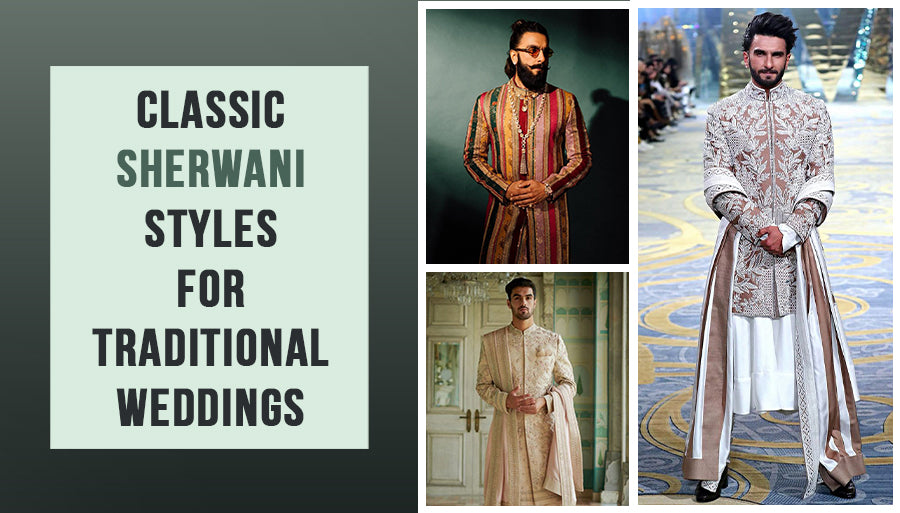
What Makes a Sherwani Truly Traditional
The word "traditional" in sherwani dressing refers to three distinct elements working together: the silhouette convention, the craft technique used for embellishment, and the fabric heritage. A sherwani can have one of these and still look beautiful. When all three are present, it carries a quality that is immediately recognisable, even to someone who cannot articulate why.Silhouette Convention
Traditional sherwani silhouettes are defined by length (knee to ankle), a closed Nehru collar, structured shoulders, and a fitted body that flares slightly from the waist. Variations on this silhouette, such as the achkan, angrakha, and Jodhpuri, each carry specific cultural and regional traditions that distinguish them from each other and from contemporary designs.Embroidery Traditions
Four major hand-embroidery traditions dominate classic sherwani craftsmanship. Zari uses metallic gold or silver thread woven or embroidered into the fabric surface, creating designs that catch light at every angle. Zardosi is a more raised technique where thick gold or silver wire and metal strips are used to create three-dimensional embossed designs, traditionally used in royal court garments. Resham uses silk thread for embroidery, producing softer, more colourful designs than metallic zari. Chikankari, originating in Lucknow, uses white thread on white or pastel fabric to create delicate shadow embroidery through a variety of stitching techniques.Fabric Heritage
Heritage sherwani fabrics have geographic origins tied to India's weaving traditions. Banarasi brocade comes from Varanasi. Jamawar, with its intricate woven patterns, originates in Kashmir. Katan silk, a tightly woven pure silk, is one of the finest base fabrics for hand embroidery. Each carries a craft story that machine-made synthetic alternatives cannot replicate in quality, drape, or longevity.Classic Sherwani Silhouettes and Their Heritage
The Traditional Full-Length Sherwani
The classic full-length sherwani is the ceremonial foundation of Indian men's wedding fashion. Its structure has remained largely consistent for centuries: a long coat-style garment falling between the knee and ankle, a closed Nehru collar, and a fitted body with structured shoulders. The embroidery follows predictable but deeply meaningful conventions, with the neckline, placket, cuffs, and hem receiving the most detailed work while the body fabric is allowed to breathe. Motif traditions in classic sherwanis are drawn from Mughal court design: paisleys (kairi), floral arrangements (phool buta), lattice patterns (jaal), and vine scrollwork (bail). These are not decorative choices made for fashion trends; they carry centuries of cultural meaning in Indian textile tradition. Cultural context: The full-length sherwani became the dominant groom silhouette during the Mughal era, when court fashion spread through the subcontinent. The elements we consider "traditional" today, including the collar treatment, the embroidery placement conventions, and the fabric choices, largely originate from 16th and 17th-century court dress.
Best occasions: Baraat, pheras, and any main ceremony function.
Styling: Churidar pants elongate the silhouette. A full dupatta and pagdi completes the ceremonial look.
Cultural context: The full-length sherwani became the dominant groom silhouette during the Mughal era, when court fashion spread through the subcontinent. The elements we consider "traditional" today, including the collar treatment, the embroidery placement conventions, and the fabric choices, largely originate from 16th and 17th-century court dress.
Best occasions: Baraat, pheras, and any main ceremony function.
Styling: Churidar pants elongate the silhouette. A full dupatta and pagdi completes the ceremonial look.

Mughal-Inspired Achkan Sherwani
 The achkan is a slim, knee-length structured coat with a closed collar and a clean front closure. It traces its heritage to the Mughal court more directly than any other sherwani silhouette, closely resembling the garments worn by Mughal nobles and later adopted as formal dress by Indian royalty during the colonial period.
What distinguishes the achkan from the full sherwani is restraint. The embroidery is typically more controlled, concentrated at the collar, cuffs, and buttons rather than spread across the entire body. This makes it more wearable across a wider range of functions and more adaptable to contemporary styling without losing its traditional character.
Cultural context: The achkan was the preferred court garment of the later Mughal period and became the formal ethnic wear of choice for Indian nobility and political figures through the 20th century. Jawaharlal Nehru's adoption of this collar style internationally made it recognisable worldwide.
Best occasions: Pre-wedding ceremonies, engagement functions, receptions where a lighter traditional look is preferred.
Styling: Slim-fit trousers for a contemporary reading. Dhoti for a deliberately traditional statement. A stole or shawl in a complementary colour adds heritage weight without full dupatta formality.
The achkan is a slim, knee-length structured coat with a closed collar and a clean front closure. It traces its heritage to the Mughal court more directly than any other sherwani silhouette, closely resembling the garments worn by Mughal nobles and later adopted as formal dress by Indian royalty during the colonial period.
What distinguishes the achkan from the full sherwani is restraint. The embroidery is typically more controlled, concentrated at the collar, cuffs, and buttons rather than spread across the entire body. This makes it more wearable across a wider range of functions and more adaptable to contemporary styling without losing its traditional character.
Cultural context: The achkan was the preferred court garment of the later Mughal period and became the formal ethnic wear of choice for Indian nobility and political figures through the 20th century. Jawaharlal Nehru's adoption of this collar style internationally made it recognisable worldwide.
Best occasions: Pre-wedding ceremonies, engagement functions, receptions where a lighter traditional look is preferred.
Styling: Slim-fit trousers for a contemporary reading. Dhoti for a deliberately traditional statement. A stole or shawl in a complementary colour adds heritage weight without full dupatta formality.
Layered Angrakha Sherwani
 The angrakha is arguably the most historically rooted silhouette in Indian men's clothing. Its defining feature is an overlapping front panel that fastens at the side rather than at the centre, creating an asymmetric layered appearance. The word angrakha means "body protector" in Sanskrit, and historical records of this garment style trace back well before the Mughal period.
The areas around the side closure are traditionally adorned with detailed tassels, embroidery, and decorative work, while the rest of the body carries complementary but less dominant detailing. This design logic, where the closure itself becomes the focal point of ornamentation, is unique to the angrakha and gives it a visual complexity that other sherwani styles do not share.
Cultural context: The angrakha appeared in miniature paintings of Rajput courts and Mughal nobles from the 15th century onward. Its revival in contemporary groom fashion is driven by grooms who want something visually distinct with genuine historical depth, rather than a contemporary interpretation of traditional aesthetics.
Best occasions: Traditional theme weddings, pheras, any function where heritage character is the priority.
Styling: Dhoti pants honour the silhouette's heritage roots most authentically. A royal turban completes the period aesthetic.
The angrakha is arguably the most historically rooted silhouette in Indian men's clothing. Its defining feature is an overlapping front panel that fastens at the side rather than at the centre, creating an asymmetric layered appearance. The word angrakha means "body protector" in Sanskrit, and historical records of this garment style trace back well before the Mughal period.
The areas around the side closure are traditionally adorned with detailed tassels, embroidery, and decorative work, while the rest of the body carries complementary but less dominant detailing. This design logic, where the closure itself becomes the focal point of ornamentation, is unique to the angrakha and gives it a visual complexity that other sherwani styles do not share.
Cultural context: The angrakha appeared in miniature paintings of Rajput courts and Mughal nobles from the 15th century onward. Its revival in contemporary groom fashion is driven by grooms who want something visually distinct with genuine historical depth, rather than a contemporary interpretation of traditional aesthetics.
Best occasions: Traditional theme weddings, pheras, any function where heritage character is the priority.
Styling: Dhoti pants honour the silhouette's heritage roots most authentically. A royal turban completes the period aesthetic.
Jodhpuri Sherwani: Rajputana Royal Heritage
 The Jodhpuri suit originates from the royal courts of Jodhpur in Rajasthan, developed during the late 19th century as the Maharaja of Jodhpur's court adapted Western tailoring conventions to Indian formal dress requirements. The result was a fitted, structured jacket with a high mandarin collar and precise button closure, typically paired with straight Jodhpur breeches.
What makes the Jodhpuri distinctive among traditional sherwanis is its architectural quality. Where the classic sherwani relies on embroidery and fabric richness for visual impact, the Jodhpuri relies on precise cut and structure. The embellishment is controlled: metallic buttons, detailed zari or beadwork at the collar and cuffs, and occasionally embroidery along the placket. The rest of the jacket surface is typically left clean.
Cultural context: The Jodhpuri became internationally known as the "Nehru suit" in Western fashion, though this attribution is historically inaccurate. Its adoption by Indian royalty and political figures throughout the 20th century gave it an association with formal Indian authority that no other men's ethnic garment shares.
Best occasions: Receptions, engagement functions, formal family events. The Jodhpuri suit reads most appropriately at functions where formal presence is required but the full ceremony weight of a classic sherwani is not.
Styling: Jodhpur breeches for historical authenticity. Slim churidar for contemporary elegance. Pastel fabric tones with bright zari embellishment create the most visually refined result.
The Jodhpuri suit originates from the royal courts of Jodhpur in Rajasthan, developed during the late 19th century as the Maharaja of Jodhpur's court adapted Western tailoring conventions to Indian formal dress requirements. The result was a fitted, structured jacket with a high mandarin collar and precise button closure, typically paired with straight Jodhpur breeches.
What makes the Jodhpuri distinctive among traditional sherwanis is its architectural quality. Where the classic sherwani relies on embroidery and fabric richness for visual impact, the Jodhpuri relies on precise cut and structure. The embellishment is controlled: metallic buttons, detailed zari or beadwork at the collar and cuffs, and occasionally embroidery along the placket. The rest of the jacket surface is typically left clean.
Cultural context: The Jodhpuri became internationally known as the "Nehru suit" in Western fashion, though this attribution is historically inaccurate. Its adoption by Indian royalty and political figures throughout the 20th century gave it an association with formal Indian authority that no other men's ethnic garment shares.
Best occasions: Receptions, engagement functions, formal family events. The Jodhpuri suit reads most appropriately at functions where formal presence is required but the full ceremony weight of a classic sherwani is not.
Styling: Jodhpur breeches for historical authenticity. Slim churidar for contemporary elegance. Pastel fabric tones with bright zari embellishment create the most visually refined result.
Printed Sherwani: A Contemporary Traditional Alternative
 The printed sherwani represents the point where traditional silhouette meets contemporary surface treatment. The structure, length, and collar conventions of the classic sherwani remain intact; what changes is how the visual richness is achieved. Rather than hand embroidery, printed sherwanis use digital or block printing to create floral, geometric, or heritage-inspired motifs across the fabric surface.
This is not a lesser option than embroidered styles. It is a different option with specific advantages: lighter weight, more adaptable to warm weather and outdoor functions, and more accessible in terms of care and maintenance. A well-designed printed sherwani in traditional motifs, such as paisleys or Mughal florals, reads as contemporary-traditional rather than casual.
Best occasions: Mehendi ceremony, cocktail parties, pre-wedding celebrations, and any function where the groom or guest wants traditional silhouette without full ceremony formality.
Styling: Solid-coloured bottoms are essential. A printed sherwani needs a clean base to prevent the overall look from reading as too busy. Minimal accessories allow the print to remain the focal point.
The printed sherwani represents the point where traditional silhouette meets contemporary surface treatment. The structure, length, and collar conventions of the classic sherwani remain intact; what changes is how the visual richness is achieved. Rather than hand embroidery, printed sherwanis use digital or block printing to create floral, geometric, or heritage-inspired motifs across the fabric surface.
This is not a lesser option than embroidered styles. It is a different option with specific advantages: lighter weight, more adaptable to warm weather and outdoor functions, and more accessible in terms of care and maintenance. A well-designed printed sherwani in traditional motifs, such as paisleys or Mughal florals, reads as contemporary-traditional rather than casual.
Best occasions: Mehendi ceremony, cocktail parties, pre-wedding celebrations, and any function where the groom or guest wants traditional silhouette without full ceremony formality.
Styling: Solid-coloured bottoms are essential. A printed sherwani needs a clean base to prevent the overall look from reading as too busy. Minimal accessories allow the print to remain the focal point.
Heritage Fabrics in Traditional Sherwanis
The fabric is where a traditional sherwani's quality most directly shows, and where the price difference between genuine heritage cloth and machine-made alternatives is most immediately felt when you put it on.Brocade and Jamawar: Woven Silk Heritage
Brocade is a woven fabric where supplementary weft threads create raised patterns directly in the weave structure, rather than embroidered onto a plain base. Banarasi brocade from Varanasi is the most celebrated Indian weaving tradition, using real silk or silk-metallic thread combinations to create patterns ranging from simple geometrics to extraordinarily complex floral arrangements. The brocade holds embroidery differently from plain weaves, creating a visual richness that combines woven and embroidered texture layers. Jamawar originates in Kashmir, where it was traditionally woven on hand looms using a twill weave technique that creates intricate, reversible patterns. A genuine hand-woven jamawar sherwani is among the most expensive and time-intensive pieces in Indian men's ethnic wear, requiring months of weaving time per metre. Machine-woven jamawar-print fabric is widely available at a fraction of the cost and serves most wedding purposes well, though the difference in drape and surface quality is apparent to touch.

Velvet: The Winter Ceremony Fabric
Velvet has been associated with royal dress across multiple cultures for centuries, and in Indian men's ethnic wear it occupies a specific ceremonial territory: deeply saturated colour, heavy texture, and a surface that catches and holds light in a way no other fabric does. The pile structure of velvet creates a directional sheen that changes the apparent colour of the garment depending on the angle of light, making velvet sherwanis particularly dynamic in candlelit or warm artificial lighting conditions typical of evening wedding functions. Traditional embroidery on velvet uses techniques that work with the pile structure rather than against it. Zardosi, with its raised metallic wire work, sits beautifully on velvet pile because the embossed embroidery and the compressed pile create a textural contrast that is visually dramatic. Resham embroidery on velvet creates a different effect: the silk thread catches light differently from the velvet background, making even relatively simple embroidery designs appear complex and layered.

Raw Silk and Katan Silk: The Foundation Fabrics
Raw silk, or tussah silk, has a natural slub texture that gives it a matte, slightly irregular surface compared to the smooth sheen of processed silk. This texture holds embroidery beautifully, creates a clean silhouette, and drapes with the structural weight appropriate for a formal sherwani without the heaviness of brocade or velvet. It is also more comfortable to wear for extended periods, making it the most practical choice for main ceremony functions like pheras where the groom sits cross-legged for hours. Katan silk is tightly woven pure silk with a smooth, lustrous surface. It is one of the finest base fabrics for zari and zardosi embroidery because the smooth weave allows embroidery threads to lay flat and catch light evenly. Katan silk sherwanis have a formal, polished appearance and hold their silhouette well through a long wedding day.
Georgette: Lightweight Heritage for Summer Ceremonies
Georgette is a lightweight, slightly textured woven fabric made from highly twisted yarns that give it its characteristic crinkled surface and fluid drape. In sherwani construction it is used most effectively for summer and destination weddings, where the breathability and natural movement of the fabric make it significantly more comfortable than silk or velvet alternatives. Lucknowi georgette with chikankari embroidery is one of the most refined combinations in Indian men's ethnic wear. The delicate shadow embroidery on the fluid georgette base creates a sherwani that reads luxurious without visual heaviness, and photographs beautifully in the natural daylight conditions common at outdoor summer ceremonies.
Embroidery Traditions in Classic Sherwanis
Zari: Gold and Silver Thread Embroidery
Zari is metallic thread made from fine gold or silver wire wrapped around a silk or cotton core thread. It has been used in Indian textile embroidery for centuries, with the Mughal court elevating it to one of the primary markers of formal and ceremonial clothing. In sherwani embroidery, zari work creates the characteristic gold-on-fabric brilliance that most people associate with traditional Indian men's wedding dress. The quality of zari varies significantly. Real gold or silver zari, though rarely used in contemporary sherwanis due to cost, has a warmth and depth that metallic synthetic alternatives cannot match. High-quality metallic zari sits flat against the fabric and catches light evenly. Lower quality metallic threads can tarnish over time and lose their reflective quality.
Zardosi: Raised Three-Dimensional Embroidery
Zardosi takes zari embroidery into three dimensions. Where flat zari work lies against the fabric surface, zardosi uses thick wire, metal strips, and sometimes semi-precious stones or beads to create raised, embossed designs. The technique originates in Persia and came to India through the Mughal court, where it was used extensively in royal garments, upholstery, and ceremonial objects. On a sherwani, zardosi embroidery creates a visual texture that is immediately readable from across a room. The raised work catches light from multiple angles as the wearer moves, creating a dynamic visual effect that flat embroidery cannot produce. It is the most labour-intensive and typically the most expensive embroidery technique available in Indian men's ethnic wear.
Resham: Silk Thread Embroidery
Resham uses silk thread for embroidery, producing a softer, more colourful result than metallic zari. The silk thread has a natural sheen that catches light gently rather than dramatically, making resham embroidery more subtle in effect and more appropriate for daytime and outdoor ceremony conditions where strong metallic embroidery can appear overpowering under direct sunlight. Resham is also the foundation of chikankari embroidery from Lucknow, where it is used on fine white or pastel fabrics in dozens of distinct stitch types that create patterns ranging from simple outline work to complex three-dimensional textures. A chikankari sherwani in cream georgette or muslin represents the lighter end of the traditional sherwani spectrum, appropriate for summer ceremonies and functions where maximum comfort is required.All-Over Embroidery vs Border Embroidery
The placement and density of embroidery carries as much meaning as the technique used. All-over embroidery, where the design covers most of the fabric surface, creates maximum visual impact and is traditionally associated with the most formal, ceremonial contexts, particularly baraat and pheras. Border embroidery, concentrated at the hem, cuffs, collar, and placket on a relatively plain body fabric, creates a more refined, restrained effect appropriate for reception and engagement functions. The choice between the two depends on the function, the fabric, and the formality of the occasion. A velvet sherwani with all-over zardosi embroidery at the baraat communicates maximum ceremonial grandeur. The same silhouette with border-only embroidery at the reception reads sophisticated and considered rather than theatrical.


